![Logo-RGB-color-solid.png]](https://help.kahlerautomation.com/hs-fs/hubfs/Logo-RGB-color-solid.png?height=40&name=Logo-RGB-color-solid.png)
A | B | C | D | E | F | H | I | J | K | L | M | N | O | P | R | S | T | V
A
Air Purge — Used to clear out the line after running an order. On carriers, it is plumbed in after the line valve. For weigh tanks, it is after the line valve connected to the tank and before the pump. Should be set to 20-30 psi.[TR1]
Actuator — Part of a valve assembly. Uses air pressure to open or close the valve. Kahler Automation commonly uses pneumatic actuators, but some systems may use electronic actuators.
Anticipation — A free flow estimate. When dispensing product, the controller watches for the remaining amount to become less than the anticipation amount, which tells it to stop pumps and close gates/valves.
B
Batch —System-enforced quantity split driven by fill limit.
Bay — Where a transport parks while being loaded. A bay may contain one or more discharge locations.
BOL — Bill of Lading. A ticket created by a dispense operation. See the definition of Ticket below.
Bulk Product — Inventory item at a facility and what will be dispensed. Products use bulk products in recipes. Most sites use 1:1 recipes. Panel settings are tied to bulk products to define where in the system the bulk product can be dispensed.
C
Calibration — A process for adjusting equipment. Commonly used to describe adjusting meters to report an accurate measurement of product. May also refer to the process of adjusting anticipation to dispense an accurate amount of product.
Carrier Line — A carrier line is the main line(s) of a system, and so are Rank 1 in Terminal Management TMX and should run first. Liquid facilities generally have at least one of these and may have as many as one per bay. These are normally plumbed with larger pipe for moving product out of bulk storage into the transport. Carrier products are nominally, but not always, fertilizers or water.
Check Valve — Mechanically restricts flow to one direction. These valves are typically used in tandem to automated valves as a failsafe to prevent product flowing in the wrong direction or preventing cross contamination.
Chem Inject — Any sub system of a liquid system which injects its bulk products into the carrier line. May be referred to as micros, micro inject, or micro panel. There are three major types of injection systems: weigh tank, deck scale, or flow (mass or volumetric).
- Weigh Tank Chem Inject — A weigh tank is a liquid vessel on a scale, where several products are measured by a single scale. Unlike most other liquid systems, a weigh tank is two-phase: fill and discharge. Bulk products are dispensed according to their panel bulk product settings into the weigh tank, then the discharge settings of the weigh tank push the product out, normally injected to the carrier line.
- A weigh tank will have several product lines run to it for filling. The dispense side will have a line valve under the tank, followed by the air purge inject point, the pump, a 3-way valve for recirculation of the tank, and then a diverter valve where the line joins the carrier. A weight tank is a 2300-type system.
- Deck Scale Chem Inject — Used where a small number of products need to be injected, a deck scale type is the same setup often used for chem inject on a dry tower. They consist of a tote on a deck scale, with a pump to push product. A deck scale is a 2400-type system.
- Flow Type Chem Inject — An inline meter measure product flow as it is injected. Many designs exist but all limit flow to one product at a time through a meter. Meters may be either mass of volumetric.
Constellation — Constellation is a cloud-connected system that links several locations (TMX Servers) to a central administration and interface hosted in the cloud, allowing a small team to manage the customs, products, and orders on all sites.
Compartment — A section of a transport that can hold material independently. A transport may have between 1 and 8 compartments. Each compartment can only be filled by one discharge location.
Cross Reference — Maps Kahler products to ERP codes.
D
Density — Mass divided by volume. Used to convert mass units to volume units. Setting density to "0" means no conversion can be done.
Diverter Valve — Diverter valves control the final destination of product flow. On carrier lines, the diverters control loadout locations such as bay 1 top fill, bay 2 bottom fill. Chem injects, especially weigh tanks, use diverter valves to select the carrier to select. Sometimes called a blocking valve depending on how the line is plumbed.
Discharge Location — A specific point in the facility where product is delivered and the panels that can be used.
DOCC — Door Open/Close Controller. Operates bay doors and has sensors in bar for entrance, mid bay, and exit.
Do Not Stack — Applicable to weigh tanks only. Products marked “Do not stack” cause the weigh tank to dispense any contents of the weigh tank (only contents due to order; flush/rinse does not apply), measure the product marked “Do not stack”, and then empty the weigh tank before another product may be measured. Ensures products that interact in undesirable ways do not mix in the weigh tank.
E
Eductor — A method of adding product to a system, especially where there is no weigh tank to be used for this purpose. An eductor is a cone hopper attached to a carrier line by an arrangement of four valves. As seen in the diagram, there is one valve at the bottom of the cone, two for the flow path, and a bypass valve on the main line to restrict flow and push it to the eductor.
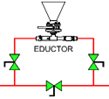
The carrier has a T-pipe leading to the eductor, followed by a bypass valve and another T-pipe where the diverted product rejoins the flow. This setup diverts part of the product flow through the eductor path where it can be mixed with product loaded in the cone and delivered to the transport. Eductors are always hand-add only.
Emulate Panel — A virtual panel used to test or train on software, and can also be used in live sites to record hand-add products. With weigh tanks, an emulate panel allows simple recording of requested amounts when the actual is not useful (due to jug rinse or other).
F
FDS — Fluid Dispensing System. Refers to a broad range of solutions focused on dispensing product or surrounding solutions.
Fill Limit — The maximum quantity a panel will dispense in a single pass, configured per panel in TMX. When an order quantity for a compartment exceeds this value, the system automatically divides it into equal-sized batches.
FLEXCOMMAND — The next generation of Kahler Automation control systems, FLEXCOMMAND integrates more of the system into PLC, eliminating components and overall delivering a better, more affordable system to customers.
Flush/Rinse — An additional measured product run alongside the order to clean lines of residue or minimize contamination risks. Can be scheduled per load, compartment, batch, or fill discharge cycle. Can be triggered any time the panel is used or per certain products. Note: A “Do not stack”ed product counts as a fill discharge cycle.
H
Hand-Add — A product that relies on the operator to dispense, as it is not available in the automation. This may be adding product to the weigh tank by hand or loading a jug onto a truck for field mixing later.
Dry towers may have a passthrough bin (no gate or bin, just a pipe straight to the weigh hopper) for this purpose. Operators dump product into the reclaim system, the leg lifts it, and then flows straight to the weigh hopper.
HMI — Human/Machine Interface. A touch screen device used to allow an operator to control a facility’s functions. VNC can be used to access and control these remotely. Connected to a PLC to function, as logic is all done on the PLC.
I
Ignition — HMI software used with FLEXCOMMAND. Eliminates hardware HMI panels for controlling and monitoring, instead using a gateway installed on one machine on the network and clients that connect to give users access.
Interface — The piece of software that brings in orders automatically and reports them back to agronomy/ERP software.
J
Jug Rinse — A manually operated sprayer head used with weigh tanks to rinse out jugs of hand-add product. The jug is placed over the sprayer head, and a switch is flipped to run water. The operator moves the jug around to ensure a good rinse, then turns off the sprayer.
K
KACO — Kahler Automation Corporation. Abbreviation used in many applications.
L
Line Valve — The LV prefix is assigned to any automated valve that has the purpose of keeping fluid in a measuring device. These valves are typically on the discharge side of a flow meter or weigh tank.
Load — A single dispensing event against an order. A load may fulfill the entire order, part of it (when an operator dispenses less than the full amount at one time), or draw from multiple orders sequentially (as with a loadout group). A ticket is generated per order in a load.
Loadout Software — Any Kahler Automation software which may be used to request orders to be dispensed by the system, e.g. Plant Supervisor PSX, Self Serve 2, and Container Filling / Tracking 2.
LOADPASS — A remote/cloud service that allows a driver to configure an order from their phone and have it staged when they check in on-site.
Low Flow Valves — Used to lower flow rates on carriers, allowing chem injects to function. Chem inject pumps may not be able to overcome the force from the carrier pump and dispensing stalls. Engaging low flows reduces the force needed to allow product to inject.
- Following panels are set up to enable low flow valves when they are dispensing, i.e. when their product valve or line valve is engaged.
- PLC/hardware may be configured to engage low flow via a diverter bit so that the low flow is engaged for the full order.
M
Manifold — Pipes joining together. Two-plus inputs, one output. Generally, goes into a measurement device.
Mass Flow Meter — Coriolis effect meter. Able to read product temperature, density, and flow rate.
MMS — Micro Measurement System.
N
Night Valve — Automatic valves on bulk product tanks which isolates product line from the tank, so the system always fails safely. These are spring return valves that close when they lose pressure.
O
Over Scaling % — Allows an operator (PSX) or driver (SS2) to dispense an order past its request amount with no warnings. Used so that trucks may be filled and not sent out as a partial.
P
Panel Bulk Product Settings — Used to tie a bulk product to a panel function and includes settings to control behavior for accurate dispensing.
Panel Function — General term for capability of a controller called for on the order grid. Some of these functions have specific reserved effects, while others are used to denote products being requested. Special functions include “Wait for start”, “Pause”, “Discharge” “Automatic Discharge”, and others.
PLC — Programmable Logic Controller. A device used to control industrial systems.
PSX — Plant Supervisor PSX. Loadout software designed to be used by an operator. Provides greater control and visibility.
Product — The material requested in orders. Use recipes to tie to bulk products (inventory items). Structuring this way allows sites the flexibility of offering a product and blending it as needed to fulfil an order’s request amount.
Product Number — Panel Functions 1-79 are often referred to as “Product Number(s)”. These are commonly useable in panel bulk product settings to associate a bulk product to a specific location/valve/pump in a facility. A special case is hand-adds, which may appear as product number 99.
Product Valve — Controls when a product can be dispensed. These are the last valve before a manifold or chem inject point.
Pulse Meters — A calibrated sensor that emits a pulse per unit of volume. This is in contrast to other system types that operate by mass (pounds). While dispensing product, the controller counts pulses to measure product flow.
Pulse counting may be done directly by the KA, or with a pulse counting panel.
- Pulse meters require the pulses per unit of volume to be configured in “Panel bulk product settings” within Terminal Management TMX. This should be set according to the pulse meter used.
R
RB Panels — Predecessor to 4000/5000 HMI systems. These panels have physical switches.
Receiving — Systems which enable the intake of product into a facility and store it in bulk for later use.
Recirculation — Controlled by recirculation panel functions on the weigh tank panel of Terminal Management TMX (start recirculation, stop recirculation, timed recirculation) when included in a product recipe. It is used to agitate the weigh tank for adding products, either dry additives or products that may not mix due to their viscosity (thickness).
Recirculation Valve — The automated valve that allows flow back into a weigh tank for the purpose of mixing the product.
Recipe — Defined way to make a product from inventory items. See definition of Product above.
Reclaim — The systems, often on dry facilities, situated between bulk storage and loadout systems, enabling an operator to fill a loadout system. May include conditioners, legs, and distributors.
Repack — A system designed to take bulk product and fill smaller containers with it. Normally done via a deck scale and pistol grips. Nominally these are teed off the product line prior to another measurement device so the systems can run independently while a deck scale is used to fill a container.
Rinse Valve — Typically used in weigh tanks or liquid blenders for the purpose of running water in the tank to clean chemical residue after a batch.
S
Scale Break — Also called division, a scale break is the minimum weight change that a meter can report, i.e. a scale configured with 2 lbs. scale breaks can only report 0 lbs., 2 lbs., 4 lbs., and so on.
Self Serve 2 — Loadout software designed to be used by authorized drivers/customers. Can limit controls and visibility to show only what is needed.
Server — A computer hosting a program, making it available. In many cases with Kahler Automation software, this refers to the machine actually running Terminal Management TMX. Alternatively, it may refer to the machine running KA-2025 Panel Server or Truck Traffic Control.
Soft Start — Motor controller that allows starting large motors slowly, protecting equipment from being hit with sudden amounts of high torque, as well as with less peak amperage, minimizing brownouts.
Software — A general term for a program running on a computer that can be replaced, updated, removed, or modified without changes to the hardware of the machine. Contrast with firmware which may require specific connection types, knowledge, or other measure to change, or hardware which requires actual physical changes.
Static IP — An address used to identify a computer on a network. Is set up so the computer will always receive the same address.
Surge Hopper — A bin under the mixer that can take blended product before it goes into the transport. Allows blending an order prior to truck being in position or halting the transport filling as needed. Frequently manually operated but can be automated.
T
Ticket — A record of a dispense operation. Tied to an order, which is a request for product to be dispensed. May be referred to as BOL (see definition above). Customers may refer to orders as tickets due to their agronomy/ERP system.
Transmitter — The logic unit of a mass flow meter. Takes the raw readings from the meter and outputs density and mass flow. Can be calibrated.
Transport — The vehicle being loaded at a facility, whether a truck, tanker, or rail car. The term covers whatever is being loaded at any given time.
TLM — Tank Level Monitoring. Reads sensors on tanks and reports their levels. May have alarms configured and trends may be recorded in Terminal Management TMX if connected.
TMX — Terminal Management TMX. Runs off a server machine and may be accessed over the network with a web browser.
TSA — Touch Screen Assembly. May be inside or out and has a touch screen. Runs software such as Bulk Product Receiving, Self Seve 2, or LOADPASS kiosk.
V
VFD — Variable Frequency Drive. Motor controller used to drive pump motors. Allows adjusting their running speed and power.